
VERTICAL GARDEN
100% MADE IN FRANCE
Living wall : everything you need to know to specify or design your project
VERTICAL GARDEN
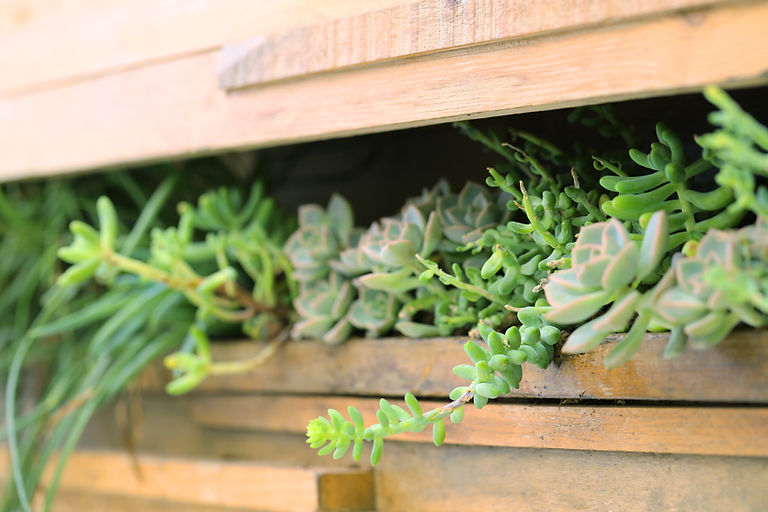
A living wall — also known as a vertical garden, green wall or living plant wall — is a vertical greening structure integrating real living plants into a self-contained growing system fixed to a wall, facade or partition. Unlike stabilised or artificial solutions, a living wall evolves over time, breathes, filters the air and requires regular professional maintenance.
At Vertiss, this system is built around the Vertiss Plus module: a modular growing system in high-density EPP, with a specialised vertical growing medium and automated drip fertigation, manufactured in France by Novintiss.
Living wall, vertical garden, green wall, VGS : what are the differences ?
These terms all refer to the same reality — a vertical surface planted with living plants — but correspond to different usage contexts.
The term vertical garden is widely used for small to medium-sized indoor or outdoor installations, often in residential or commercial settings. The term green wall or living wall is more commonly used in professional architecture and landscaping circles, particularly internationally. The term VGS (Vegetated Green System) or green wall cladding is the technical designation used in construction specifications and tenders — the vocabulary of architects and structural engineers for a living wall integrated into the building envelope as a facade system.
The Vertiss Plus system is compatible with all three applications: indoor installation on a partition wall, outdoor vertical garden, and green wall cladding on a new build or renovation facade.
Which plants for a natural living wall, indoors or outdoors ?
Plant selection is one of the most important decisions in designing a living wall.
It directly determines the longevity of the installation, the maintenance workload and the aesthetic result over time.
The vast majority of perennial plants are technically compatible with vertical growing. However, several key parameters must be assessed to ensure the success of the project:
Climate and exposure
an outdoor living wall on a north-facing facade in northern Europe will not call for the same species as an installation in full sun on a south-facing Mediterranean facade. For indoor installations, the available light intensity — natural or artificial — is the determining factor.
Plant behaviour
the growth habit of plants (upright, trailing, spreading, ground-covering) directly influences competitive dynamics within the module. A trailing species such as Glechoma can quickly smother a ground-covering species such as Helxine if their cohabitation is not planned carefully. The planting density of 16 plants per module requires careful selection of plant combinations.
Cultural requirements
growing medium pH, nutrient needs, frost sensitivity for outdoor installations, and drought tolerance between irrigation cycles must all be taken into account.
The final plant selection is always made by the professional installer in consultation with the client, based on the specific constraints of the site. Vertiss supports its installers with technical recommendations on plant combinations according to installation context.
Benefits of a living wall : well-being, thermal, acoustic and property value
Thermal comfort and building envelope performance
On exterior facades, plant evapotranspiration generates a natural cooling effect in summer, reducing solar heat gain on the load-bearing wall.
The Vertiss Plus EPP module provides additional thermal insulation for the growing medium and root systems, including in zones with extreme temperatures.
In winter, the structure creates an air gap between the support and the modules that helps limit thermal losses.
Acoustic attenuation
The growing medium and plant mass of a living wall absorb and diffract sound waves. Indoors, a living wall helps reduce reverberation in large volumes — entrance halls, open-plan offices, restaurants.
Outdoors, it contributes to attenuating urban noise pollution penetrating the building.
Design and real estate value
A living wall is a strong architectural statement that visually transforms a space or facade.
It distinguishes a hotel, reinforces the identity of a corporate headquarters, or adds value to a building in terms of labels and environmental certification.
Facade greening is also an increasingly important criterion in urban planning regulations and urban biodiversity initiatives in major cities worldwide.
 vertiss_crespin_plante_web |  vp_ext_crespin_02_webDescribe your image |  vertiss_crespin_webDescribe your image |
|---|---|---|
 vertiss_crespin_plante_02_webDescribe your image |  Add a TitleDescribe your image |